The Dr. James Milgram Collection of Western Postal History
Lot 523
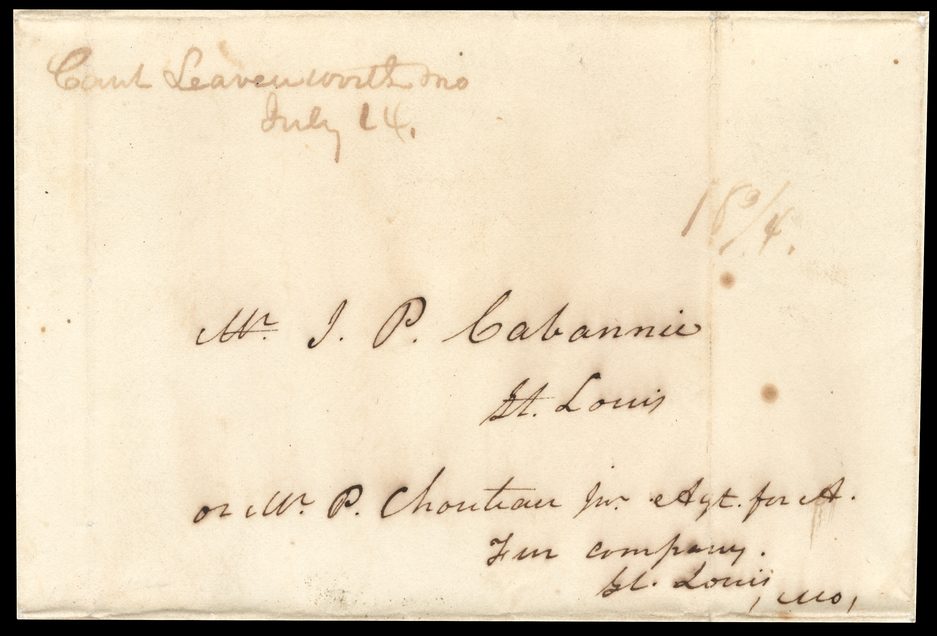
Cant. Leavenworth Mo. July 14 [1829],
manuscript postmark with matching "18¾" rate on folded letter to "Mr. J. P. Cabanne, St. Louis, or Mr. P. Chouteau Jr. Agt for A. Fur Company, St. Louis Mo.", datelined "Cant. Leavenworth 11th July 1829" with contents, in part, "…I requested that you would make out and transmit to me at this place, triplicate accounts duly receipted covering and embracing the amount of goods furnished R. P. Beauchamp, Sub. Ind. Agent, for the American Fur Company, in the months of March and April last, at the four Pawnee villages, and delivered by him to the Indians in council at those several places. From the lapse of time since I left there, and the accounts not having reached me, it is presumed the despatch may have escaped your memory…The goods were delivered at four different villages, on different days, to wit: on the 24th of March at the Loup; on the 25th at the Icarza; on the 28th at the Grand Pawnee; and on the 1st of April at the Republican, to the Indians in council…R. DeRussey, Bvt. Maj. U.S. Agt…", couple vertical file folds, F.-V.F., this cover represents one of the earliest known uses from what later became Fort Leavenworth (built 1827)., ex-Baughman and Jarrett.
Estimate $750 - 1,000.
Early in the year 1827, the War Department ordered Col. Henry Leavenworth to follow the Missouri River until he reached the mouth of the Little Platte River, and established a permanent military cantonment on the east bank of the river. Col. Leavenworth explored the area, and determined that the west side (ultimately the Kansas) side of the river was the best site for the construction of the cantonment. Due to its strategic location on what was to become the Oregon Trail, Fort Leavenworth became a key supply station on the westbound route settlers took on their long journey to California, Oregon and Utah.