The Richard Malmgren Collection of Hawaii
Lot 109
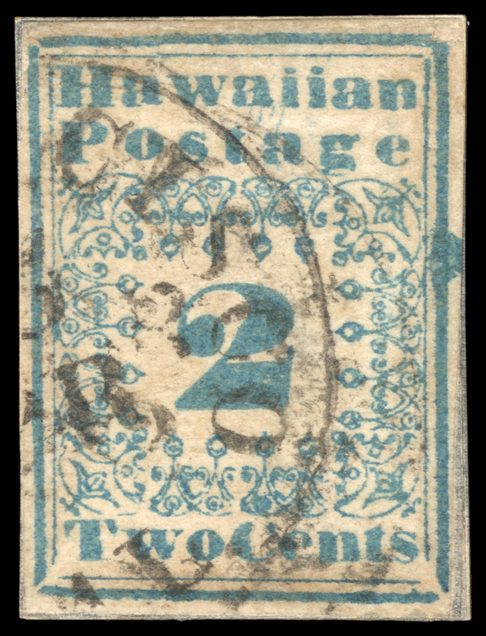
Hawaii, 1851-52, "Missionary" Issue, 2¢ blue, Type II,
neat strike of "San Francisco, Cal., Apr 16" town cancellation, ample to mostly large margins all around, bold color, with only a small surface scrape at top, light creases and with no added restoration, mounted on tissue paper to strengthen and then onto card, Very Fine, Siegel Census No. 1-II-CAN-5, ex-William P. Brown, Ferrary, Hind, Atherton, Honolulu Academy of Arts, Honolulu Advertiser & Ishikawa; with 1996 P.F. certificate.
Scott No. 1 $250,000.
ONE OF THE FINEST USED EXAMPLES OF THE HAWAIIAN 2¢ MISSIONARY ISSUE AND THE ONLY EXAMPLE CANCELED BY THE SAN FRANCISCO CIRCULAR DATE STAMP - A WONDERFUL FIRST CLASS HAWAIIAN RARITY OF WHICH ONLY TEN EXAMPLES ARE IN PRIVATE HANDS
According to Meyer-Harris, when the Legislature of the Kingdom of Hawaii, on June 18, 1851, passed an act reaffirming the Decree of the Privy Council of December 20, 1850, the postmaster was authorized to have stamps of appropriate denominations printed. Postmaster Whitney immediately took steps to put this directive into effect, and the first Hawaiian stamps, the so-called "Missionaries," were placed on sale October 1, 1851. The "Missionaries" are thus called because they are nearly always found on correspondence from American missionaries in Hawaii to their friends back in the States, either in California, or in New York, Connecticut, or Massachusetts.nnThe "Missionaries" were produced at the government printing office, where the government journal "The Polynesian" was printed. The printing form was composed of two subjects side by side, each set up out of materials from a job printer's case: characters, printer's rules, and ornaments, all locked in a small chase. All three denominations, including the 2 cent value, were printed from the same form by changing the large central figure of value and the words in the bottom line.nnThe 2¢ Missionary stamp, which was intended to paid the unit rate of postage on newspapers and other printed matter to the United States, ranks as one of the world's greatest rarities. It did not have an extremely large use in the first place, and the newspaper wrappers, having no sentimental or record value, were thrown away. These two facts probably account for its great rarity. Although the intention of this issue was that of paying printed matters rates, it is shown that it was used to prepay the 2¢ ship captain's fee in Honolulu. This is most notably demonstrated on the iconic Dawson cover and most likely was the same for this stamp offered here. Another example is also known on piece in combination with the first 13¢ Missionary issue (Scott #3), which bears a San Francisco circular datestamp, and appears to represent a combination paying the triple 5¢ Hawaiian postage.