
The December Sale
Lot 976
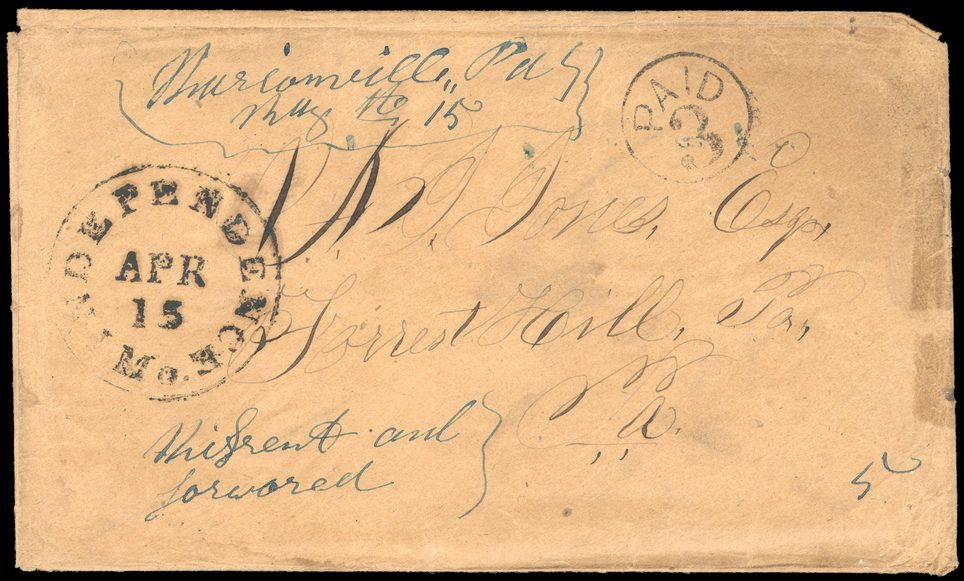
(Missouri) Pair of Historic Letters,
1.) black cds "Independence Mo. Apr 15" and "PAID 3" in circle handstamp on buff cover to Forest Hill P.O. Pa, with manuscript "missent and forwarded" along with manuscript "Marionville Pa May the 15" in blue, enclosed letter datelined Apr 13th /52 with great contents, in part, "…We are on our road to California but have had a sorrowful time since we started…We took passage at Rochester on Bord the Statesman Steamer for St. Louis which landed there the 30 ult. we remained at St. Louis till April 4th then took passage on Board the St. Ange for Independence and landed here yesterday. The evening before we left St. Louis I saw one of the most horrid sights I ever witnessed in my life. It was the explosion of the Steam Boat "Glenco" it was a sight I never wish to see again for some time the air was filled with the fragments of the boat an the bodies of men women and children…On coming up the Missouri we saw the reck of the Steamer Saluda. She was blown up last week the loss of lives was estimated at 200, and of property $30,000 in both boats…There are more than 1500 people waiting here for pasture to cross the plains. The roads are filled full of encampments for six or seven miles each way from this place and the town is also crowded…J.T. Jones," second item 2.) letter only (no cover) datelined "St. Joseph April 21st, 1850" in part, "…thair is men shot and drowned And got ded in the street by drinking whiskey…wee will start tomorrow with 100 men and 2 woman in company…when you write direct your letters to John D. Carothers, San Francisco and have some one male it that can rite…"; cover with light edge wear and tape stains right, F.-V.F., A rare first-hand account of the Steamer Glencoe explosion.
Estimate $300 - 400.
The "Glencoe" steamboat explosion occurred on April 3, 1852, in St. Louis, Missouri, when its boilers exploded shortly after mooring at the Chestnut Street levee. The blast and subsequent fire killed roughly 40 to 60 people, causing significant destruction on the riverfront. This disaster was one of several major 1852 explosions that prompted Congress to pass stricter safety regulations.